- GRIT
- Posts
- 👉 Breaking Down Corning Inc. ($GLW)
👉 Breaking Down Corning Inc. ($GLW)
Adding fuel to the fire on a legacy player with new role in AI buildout.

GRIT
05 Feb

Good afternoon.
We’re thrilled to share a comprehensive breakdown of a stock that’s quietly up +110% over the past year.
Let’s talk through everything you need to know about Corning Inc. (GLW).
If you want full access to these monthly stock picks, monthly livestreams, weekly market reports, and Austin Hankwitz’s portfolio — click here to upgrade your subscription!
As a reminder, this specific deep-dive is written by the GRIT team and is not the exclusive work of Head Analyst Austin Hankwitz.

Stock Deep Dive: Corning (GLW-US, $91B)
Corning is not just a “glass company.” It is a critical supplier to the AI and data-center buildout, sitting in the part of the stack most investors underweight: the physical infrastructure that makes compute usable at scale.
AI does not only need more GPUs. It needs more bandwidth, more interconnect density, and more fiber.
That is the quiet constraint behind the loud headlines.
While the market obsesses over chips, Corning sells the plumbing: optical fiber, cable, and specialty materials that determine whether a data center can actually move data fast enough to keep expensive compute fully utilized. And because these components are qualified, embedded, and hard to swap, wins can translate into durable demand rather than one-off orders.
This piece breaks down why the setup is improving, how Corning wins, what is driving the numbers, and where the risks still live, with a clear takeaway: if AI is the new CapEx cycle, Corning is increasingly one of the enablers investors cannot ignore.
Why Now 👉 Landmark Deal Inked
Overview 👉 What Does Corning Do?
How Do They Win? 👉 Value Proposition
Business Units 👉 Breaking Down the Segments
How Do They Make Money? 👉 Unit Sales with Long-term Supply Agreements
By The Numbers 👉 Key Metrics
Risks 👉 Potential Pitfalls
Why Now 👉 Landmark Deal Inked
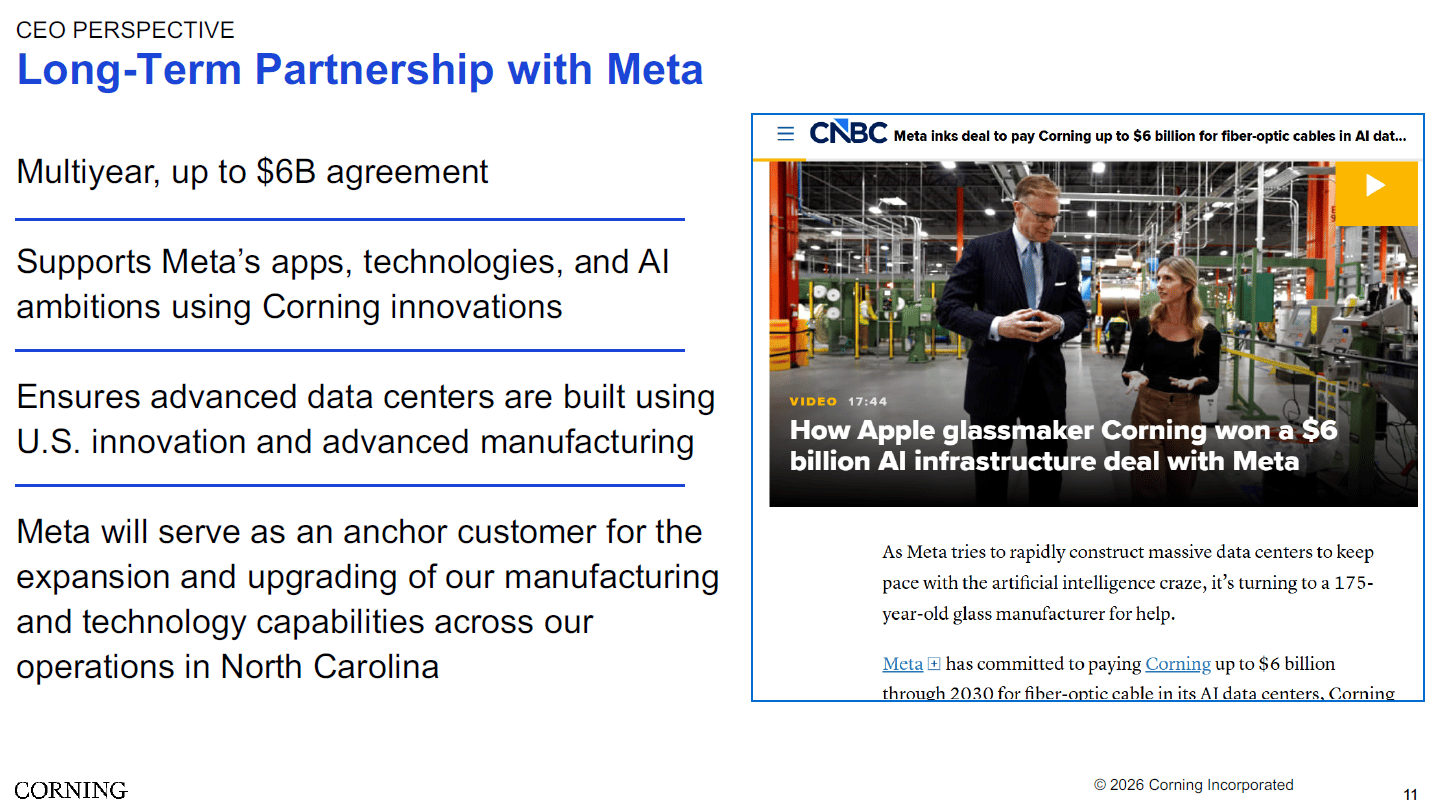
Corning’s core products (specialty glass and optical fiber) are at the heart of today’s AI and data-center boom. Generative AI demands dramatically more network capacity. Analysts note it can require roughly 10 times the fiber links per data center. Corning is capitalizing on this surge: in 2024 it agreed to supply next-generation fiber cable to Lumen (reserving ~10% of its global fiber capacity), enabling Lumen to more than double its U.S. intercity fiber network for AI workloads. In January 2026 Corning struck a multiyear (up to $6B) deal with Meta to provide advanced optical fiber, cables and connectivity for Meta’s U.S. AI data centers. These partnerships underline how Corning’s products are being tapped to “power next-generation data centers” for AI.
Source: Company Filings
Policy tailwinds further strengthen Corning’s position. Under the CHIPS Act, Corning earned ~$32M in funding to expand U.S. production of high-purity fused silica and ultra-low-expansion glass for DUV/EUV lithography which are essential materials for cutting-edge chipmaking. This supports onshore semiconductor supply chains that rely on Corning’s glass. Likewise, infrastructure spending is boosting fiber demand. Corning invested over $500M since 2020 in a new optical-cable campus in North Carolina, nearly doubling U.S. cable output to meet rising broadband needs. This aligns with federal broadband programs (e.g. BEAD) and “Buy America” requirements, ensuring Corning’s fiber is made domestically. Even on sustainability fronts, fiber networks are “green” due to fiber-optic links using far less power (and cooling) than copper, helping data centers cut energy use. Overall, secular trends in AI, data infrastructure, and government investment are converging to create a potent “why now” for Corning.
Overview 👉 What Does Corning Do?
Corning Inc. (NYSE: GLW) is a leading materials-science company, 170+ years old, specializing in specialty glass, ceramics and optical materials. It has pioneered iconic products like Gorilla Glass (tough, lightweight cover glass for phones and tablets) and the world’s first low-loss fiber-optic cable (invented in 1970). Corning serves diverse markets with five main segments.
Its Display Technologies unit makes the thin, fusion-processed glass substrates for LCD/OLED screens (TVs, laptops, monitors). Optical Communications builds fibers, cables and connectivity equipment for telecom and data networks. Environmental Technologies produces ceramic substrates and filters for vehicle emission controls (catalytic converters). Specialty Materials covers over 150 formulations, most famously Corning Gorilla Glass for mobile devices, plus precision optics for semiconductors, aerospace, defense, and more. Finally, Life Sciences supplies laboratory glassware, plastic cell-culture vessels and media under brands like Corning, Falcon and PYREX, serving biotech, pharma and research labs.
Corning’s glass and optical innovations are built into an ecosystem ranging from smartphones and flat-panel displays to cars, data centers and medical labs.
How Do They Win? 👉 Value Proposition
Proprietary Glass IP and R&D: Corning invests heavily in innovation (about $1.1 B in R&D in 2023) to develop advanced glass and optics. Its proprietary formulations (e.g. Gorilla Glass’s deep chemical-strengthening, or its ultra-pure fused silica) are backed by extensive patents. This cutting-edge IP is hard for competitors to match.
Manufacturing Scale and Efficiency: Corning operates massive, highly automated plants. For example, it is expanding two of the world’s largest fiber-cable facilities in North Carolina to meet demand. Its specialized processes (like the fusion process for display glass) and decades of manufacturing know-how give it cost and scale advantages over smaller rivals.
Quality and Reliability: Customers trust Corning for high-quality materials and a reliable supply chain. The company stresses product quality and consistency. It is the #1 global supplier of premium display glass and is widely used in critical network infrastructure, reflecting a reputation for reliability.
Strategic Customer Partnerships: Corning often locks in long-term deals and design wins with major OEMs and carriers. Recent examples include the supply agreements with Meta and Lumen, which commit customers to Corning’s new fiber solutions. Its Gorilla Glass is an entrenched standard in many smartphones (e.g. Apple’s products). These partnerships create “sticky” revenue streams and a platform for content expansion.
Diversified End Markets: Corning’s breadth across consumer electronics, telecom, automotive emissions, life sciences, etc., means that growth in one area can offset slowdowns in another. It can also cross-sell innovations across markets (for instance, a new ultra-strong glass formula might be used in both smartphones and vehicle windshields). This diversification helps stabilize its business over cycles.
Business Units 👉 Breaking Down the Segments

Subscribe to GRIT Premium to read the rest.
Become a paying subscriber of GRIT Premium to get access to this post and other subscriber-only content.
Already a paying subscriber? Sign In.
A subscription gets you:
- • WEEK IN REVIEW: Full access to the internet's best recap of the markets, every single week. This includes comprehensive earnings breakdowns, portfolio updates, and more. This is the perfect compliment to the "Investing Week Ahead" post that you already receive at the beginning of each week.
- • MONTHLY LIVESTREAMS: Join Austin Hankwitz live every month to dive deep into his portfolio, explore the latest trends, discuss any changes he’s making, and cover market-moving topics.
- • PORTFOLIO ACCESS – Austin Hankwitz, Warren Buffett, Bill Ackman, and other professional / billionaire investor portfolios.
- • MONTHLY STOCK DEEP DIVES – Comprehensive stock analysis on an individual ticker, delivered at the end of each month.
- • RESOURCES – A wide variety of investment resources for both beginners and advanced investors to accelerate your portfolio.
Reply